
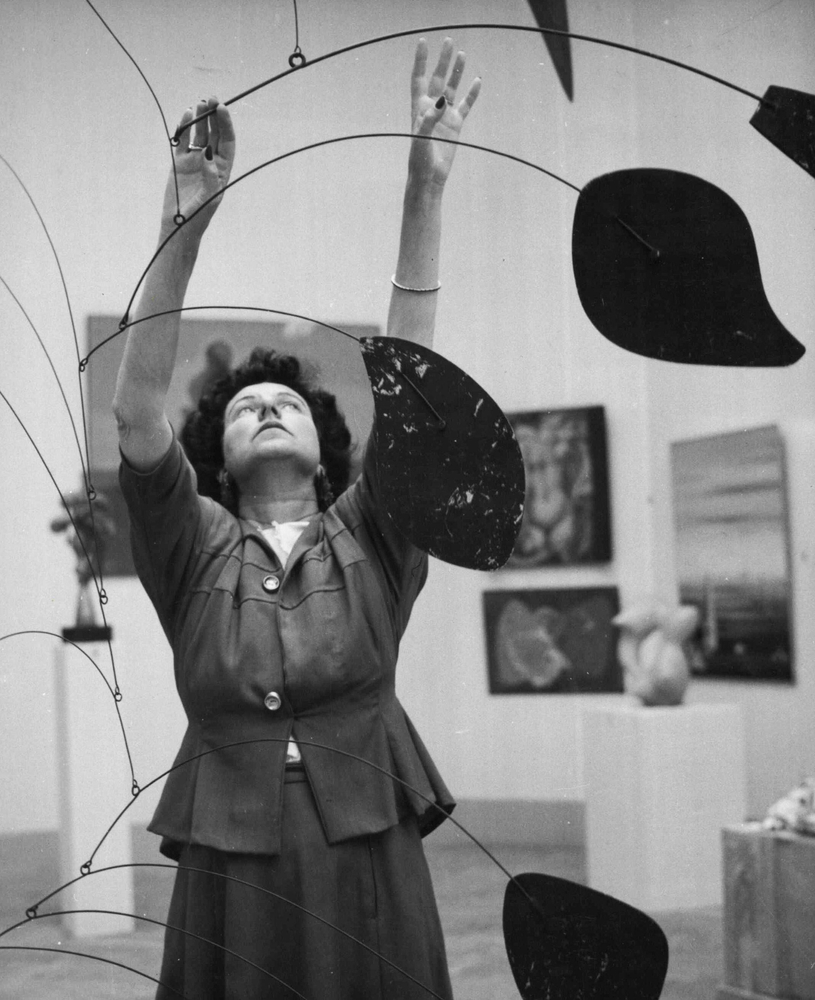
Peggy Guggenheim with a sculpture by Alexander Calder, 1949. Photo by SuperStock / Alamy.
Across the 20th century, a small but formidable group of women dealers, collectors, and gallerists helped shape the course of modern art, championing artists and, in many cases, creating the markets and audiences that sustained them. What follows are highly abbreviated portraits of four forces majeures whose decisive actions altered the trajectories of some of the most consequential artists of the century.
In 1901, the 36-year-old Berthe Weill decided to use her 4,000-franc dowry to open Galerie B. Weill in Paris’s Pigalle district. Rather than marry and surrender her maiden name, she printed it on a business card that boldly declared her intention to represent the Parisian avant-garde. Reading place aux jeunes (translated both as “place for the young” and the more declarative “make way for the young”), that calling card cemented her position in the history of modernism.
The first female art dealer in Paris, Weill also became the first person — male or female — to ever sell a work by Pablo Picasso. Even before the doors to her gallery officially opened, the Spaniard’s Post-Impressionist Le Moulin de la Galette (c. 1900), now in the collection of New York’s Solomon R. Guggenheim Museum, and several other early works passed through her hands. Two years later, buoyed by the evidence that a market for contemporary art might exist, she organized Picasso’s first exhibition: a two-person show with the now-forgotten Louis Bernard Lemaire. No Picassos sold, and she soon lost the enterprising young painter to her competitor and neighbor, the older (and notably male) Clovis Sagot.
Undaunted, Weill continued searching for fresh talent, finding it in Henri Matisse, Amedeo Modigliani, and many other artists who are now household names. Her gallery also became an early platform for a range of emerging avant-garde movements: she was the first dealer for the Dadaist Francis Picabia and the Orphist Robert Delaunay. Midway through her four-decade career, she also began devoting a significant portion of her exhibitions to women artists, including the painter Marie Laurencin.
Though long overshadowed by the artists and movements she helped bring to prominence — and by her male contemporaries — Weill’s role in shaping the early landscape of modern art has recently received renewed attention in Make Way for Berthe Weill: Art Dealer of the Parisian Avant-Garde, an exhibition that traveled from New York to Montreal and closed in Paris earlier this year.
Weill’s 1933 memoir Pow! Right in the Eye is the first by a female art dealer; by my account, Peggy Guggenheim’s 1946 Confessions of an Art Addict is the first by a woman patron. It’s hard to imagine that the two never crossed paths in Paris, where the young New York heiress — whose father went down with the Titanic — settled in 1920. Having befriended Marcel Duchamp, Yves Tanguy, Constantin Brancusi, Djuna Barnes, and the rest of the city’s artistic demimonde, Guggenheim quickly immersed herself in the avant-garde circles that would shape her collecting vision.
Famously setting herself the goal of acquiring a “picture a day,” she began buying art in earnest in 1938, doing so prodigiously from the studios of Europe’s most forward-thinking artists. It was then, in London, that she opened Guggenheim Jeune, a short-lived but influential gallery that championed abstraction and Surrealism and will soon sit at the center of Peggy Guggenheim in London: The Making of a Collector, an exhibition opening this spring at her eponymous Venetian museum.
As war spread across the continent, Guggenheim moved swiftly to safeguard both artists and artworks, fleeing Paris just days before the Nazi occupation. Back in New York, she opened Art of This Century on 57th Street, where she could show her collection to the public. Designed by Frederick Kiesler as an immersive environment for modern art, the gallery became one of the most important spaces for the avant-garde in America. There, Guggenheim did not merely collect; she actively shaped the reception of modern art in the United States, introducing audiences to artists such as Mark Rothko, Jackson Pollock, and Clyfford Still, while bringing some of Europe’s most radical movements — Cubism and Surrealism — to American viewers.
Much like Weill, Guggenheim supported female artists; in 1943, she organized The Exhibition by 31 Women, the first women-only exhibition in the United States. By the time Art of This Century closed in 1947, Guggenheim had irrevocably altered the landscape of modern art in New York — all on her own dime.
When Betty Parsons started representing Rothko — having effectively inherited him from Guggenheim, who gave the artist an important solo show in 1945 — he was just beginning his Multiform paintings. Parsons, herself a painter and sculptor, approached artists with the eye of a practitioner, perhaps even more so than as a dealer; she would later remark that the creative process interested her far more than the “tyranny of forms and finances.” The opening of the Betty Parsons Gallery in 1946 echoed Weill’s gamble more than four decades before: Parsons invested her own money in the space, trusting both her eye and the promise of a nascent generation of not-yet-understood artists.
The gallery would soon become the launching pad for Abstract Expressionism. Parsons proved an essential anchor for the notoriously mercurial Rothko. It was under her watchful eye that he debuted his luminous floating rectangles in 1950, a landmark of the movement. Helping to establish what would become the first truly international artistic movement to emerge from the United States, she fostered the careers of Pollock, Still, Barnett Newman, Adolph Gottlieb, and Agnes Martin alongside Rothko and others.
Though the gallery came to define her in the public eye, Parsons maintained her practice — a fact many forget. She had studied painting in the 1920s, but only fully committed to her work in 1947, closing the gallery every summer so that she could devote time to the studio. Bard’s Center for Curatorial Studies now aims to restore that aspect of her legacy. In June, the Hessel Museum of Art will open Betty Parsons: An Artist with a Gallery, giving Parsons her first major — and long overdue — retrospective.
Fast-forward to 1981, a year before Parsons’s death, when a new generation of artists was emerging in New York. It was then that the Rome-born Annina Nosei encountered Jean-Michel Basquiat’s drawings at PS1’s New York/New Wave exhibition. She wanted to show him at her eponymous gallery, but at that time, due to circumstance, he had created many drawings but relatively few paintings. Nosei offered the basement of her gallery at 100 Prince Street as a studio and placed Cy Twombly’s catalogue raisonné in his hands, giving the young artist both space and context in which to develop his practice.
Nosei was not only Basquiat’s first dealer, just as Weill had been for Picasso; she was also one of his most perceptive interpreters. In a 1988 interview she described his work as the “poetics of the political,” an observation as concise as it is incisive. More than a gallerist, Nosei is an academic with doctorates in both literature and philosophy.
Without her intervention, Basquiat’s meteoric rise might have taken a very different course. Without Parsons’s gallery, Rothko’s vibrating fields might have emerged far more slowly. Without Guggenheim’s self-proclaimed “art addiction,” the avant-garde might have arrived in America on far quieter terms. Without Weill’s early conviction, Picasso’s first steps into the Parisian avant-garde might have taken longer to find their footing. The history of 20th-century art was not shaped by artists alone. It was propelled by the women who recognized their importance — and acted.