
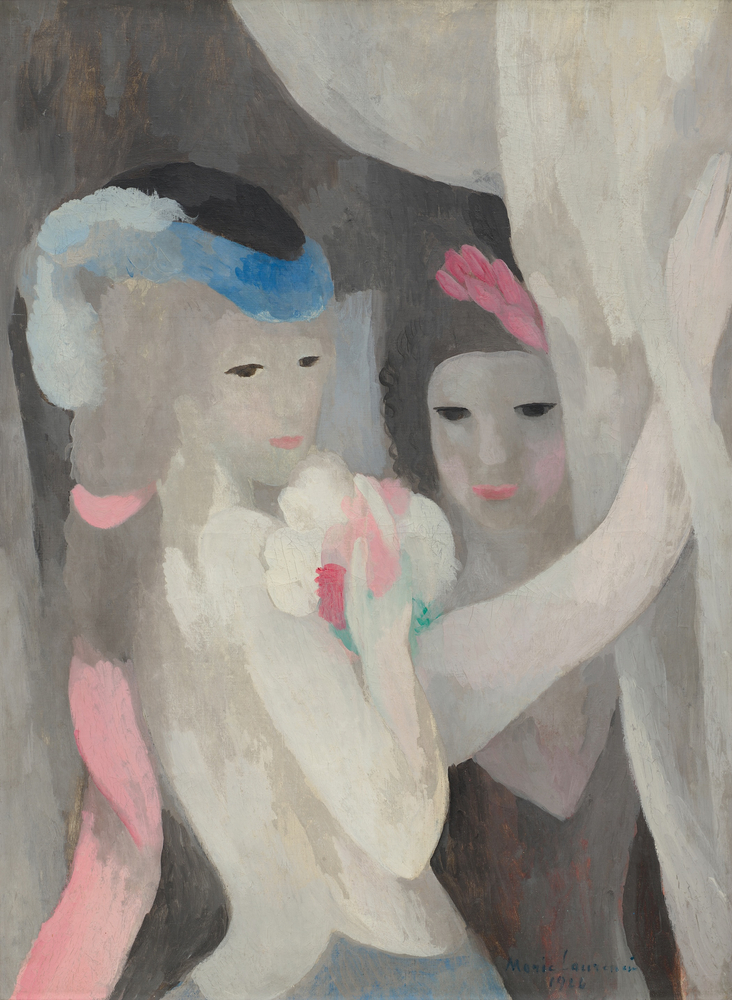
Marie Laurencin, Deux femmes au rideau (Two Women at the Curtain, 1924), oil on canvas mounted on board. © Fondation Foujita / Artists Rights Society (ARS), New York / ADAGP, Paris 2026.
There are a few men: Pablo Picasso. Paul Rosenberg, her dealer. Jean Cocteau. Guillaume Apollinaire. Some whose names are lost to history. Legend has it she charged more to paint a man’s portrait. What is certainly true is that Marie Laurencin loved to paint women, and for the most part, that’s what she did — creating a universe of women unto themselves.
Laurencin’s female utopia was long overlooked. A key figure in Paris’s early 20th-century avant-garde, she was pushed to the margins of art history following her death in 1956 and only began to receive broader recognition with feminist reevaluations of the canon in the 1970s. Among the most influential was Ann Sutherland Harris and Linda Nochlin’s landmark exhibition Women Artists: 1550–1950, which opened at the Los Angeles County Museum of Art in 1976. Even then, Laurencin’s work — her dreamworld of sensual, doe-eyed sylphs — was dismissed, often by feminist critics, as too “feminine.” “Laurencin was of the ‘lipstick lesbian’ variety,” according to Libby Otto, professor of art history at the University of Buffalo, commenting on the exhibition Marie Laurencin: Sapphic Paris — the show that changed everything.
The exhibition, on view at the Barnes Foundation in Philadelphia from October 2023 to January 2024, was anticipated by a presentation of Laurencin’s work in September of that year, when Nahmad Contemporary showcased eight of her paintings at the Independent 20th Century art fair in New York City. Today, Laurencin has reclaimed her rightful place among the major French Modernists.
Born in Paris in 1883, Laurencin emerged from humble roots — the illegitimate daughter of a seamstress — to plant herself dead center in the city’s legendary turn-of-the-century avant-garde. After studying porcelain painting in Sèvres, she returned to Paris to train at the Académie Humbert, where her talent was spotted by classmate Georges Braque. (Francis Picabia was another schoolmate.) Her first solo exhibition caught the attention of Picasso, who welcomed her into his circle at the Bateau-Lavoir in Montmartre and introduced her to his close friend Apollinaire, the writer and poet with whom she began a tumultuous affair.
She was both his lover and his muse: “She is happy, she is good, she is spiritual and she has so much talent! She is a little sun; she is me in feminine form,” Apollinaire remarked, paying a few backhanded compliments to himself in the process. He even christened her “Our Lady of Cubism,” as she frequently exhibited her works alongside the Cubist paintings of Robert Delaunay, Fernand Léger, Marcel Duchamp, Juan Gris, and others. Yet her style always remained at some remove from that of her peers — distinctly figurative, Fauve-inflected, and pointedly feminine.
Laurencin’s centrality to Paris’s early Modernist scene can be summed up in a pair of closely related compositions titled Apollinaire and His Friends. The first, also known as A Group of Artists (1908), now in the collection of the Baltimore Museum of Art, depicts Apollinaire with Picasso, his lover Fernande Olivier, and Laurencin herself. Once completed, the painting was swiftly purchased by none other than Gertrude Stein. Laurencin returned to the scene the following year, expanding the circle when she painted a larger, second version for Apollinaire to keep for himself. Now in the collection of the Centre Pompidou, that later canvas adds Stein alongside the poets Maurice Cremnitz and Marguerite Gillot. Apollinaire, in turn, wrote poetry for and about her, including “Marie,” published in 1913 not long after their roughly five-year relationship came to an end.
Laurencin left Apollinaire with the aid of the woman who would become her lover, the couturier Nicole Groult, sister of the “King of Fashion” Paul Poiret. Laurencin’s involvement with Groult continued through her brief marriage to the German aristocrat Baron Otto von Wätjen, whose German ties forced her into exile in Spain during World War I. It was in Spain, far away from the Bateau-Lavoir, that Laurencin developed her distinctive painterly voice.
“As long as I was influenced by the great men who surrounded me, I could do nothing,” she later explained. Though she had male lovers — and was buried with Apollinaire’s letters — her outlook seems to have been, in general, “sapphic,” as Barnes curators Cindy Kang and Simonetta Fraquelli term it. Freed from the orbit of her male contemporaries, she discarded Cubism’s hard angles and neutral hues, soaked up Goya at the Prado, and authored a language of female desire and intimacy to which she would return throughout her career.
But Paris beckoned. In 1921, fresh from divorce, she became a habitué of the city’s lesbian social circles. Laurencin frequented the salon of American expat Natalie Barney and was, of course, known to Stein. Unlike Barney and Stein, who lived openly — and proudly — Laurencin felt compelled to keep her same-sex relationships under a veil. Case in point: at the time of her death, she was living with Suzanne Moreau, a woman Laurencin had legally adopted, presumably to allow Moreau to inherit her estate. Presumably, also, they were more than roommates.
Instead, Laurencin demonstrated her love of women in her work, which pays homage to their beauty, their creativity, their sensuality. “Why should I paint dead fish, onions and beer glasses? Girls are so much prettier,” she famously quipped. The paintings presented at Nahmad’s Independent 20th Century show exemplify Laurencin’s talent for equivocation. Jeunes danseuses (Young Dancers, circa 1925) shows a pair of figures entwined in chaste choreography — or perhaps something more intimate. In Deux femmes au rideau (Two Women at the Curtain, 1924), two half-hidden ladies peer out toward a theater audience — or are they checking to be sure no one is there? Some of her contemporaries may have understood her work’s encrypted meanings; others, perhaps not.
Her post–World War I work has a sly, pastel eroticism, not altogether different from the Rococo paintings with which it shares a palette. In its strange, languid sweetness, and liking for a fête galante, Laurencin’s oeuvre has an umbilical connection to that of Jean-Antoine Watteau. What links them is a shared taste for atmosphere and fleeting encounters. You can trace a lineage back to the Impressionists, too. Her references also extended further afield. She took an interest in things Japanese and was likely influenced by Sei Shōnagon’s medieval diary The Pillow Book, which likewise turns its gaze on a world of women set apart.
Creatively, Laurencin got around. She shows up, Zelig-like, in the annals of interwar art, fashion, and bohemia. Here is Picasso, joking that the crouching woman at the lower right corner of Les Demoiselles d’Avignon (1907) is, in fact, Marie Laurencin. She designed sets and costumes for Sergei Diaghilev’s Ballets Russes. She published poetry in Picabia’s Dada magazine 391. She painted Vogue covers.
Fashion plate (and radical activist) Nancy Cunard sat for Laurencin; so did makeup magnate Helena Rubinstein; so did Coco Chanel, who hated the end result so much she refused to pay for the painting. It’s now in the collection of the Musée de l’Orangerie. A classic example of mature-period Laurencin, it depicts Chanel in soft-focus repose with her poodle, another dog in the background leaping at a turtledove. As well as women, Laurencin loved to paint animals — especially birds. They are one of her coded gestures; in many paintings, they are believed to symbolize Groult and/or their love for one another. “Your breasts are white birds/Your lip is a fire bird,” Groult wrote to her in 1915, during Laurencin’s exile in Spain.
Your heart is a rare bird
Easy to frighten
Savage — Tender and strange
It hides to love me.
Laurencin was famous in her lifetime — described by Vu magazine in 1930 as one of the “most celebrated women in France.” (Colette was another.) Then, after her death, she fell fast into relative obscurity and remained there for more than half a century. She could claim one notable avid fan: Hitachi executive Masahiro Takano, the collector who founded Japan’s Marie Laurencin Museum. The first museum dedicated to a single female artist, it now holds approximately 600 of Laurencin’s paintings, drawings, and prints. But in many ways her work is still undervalued. That may be because, as an artist, she’s not out to jangle anyone’s nerves. Her aim, rather, is to seduce you.